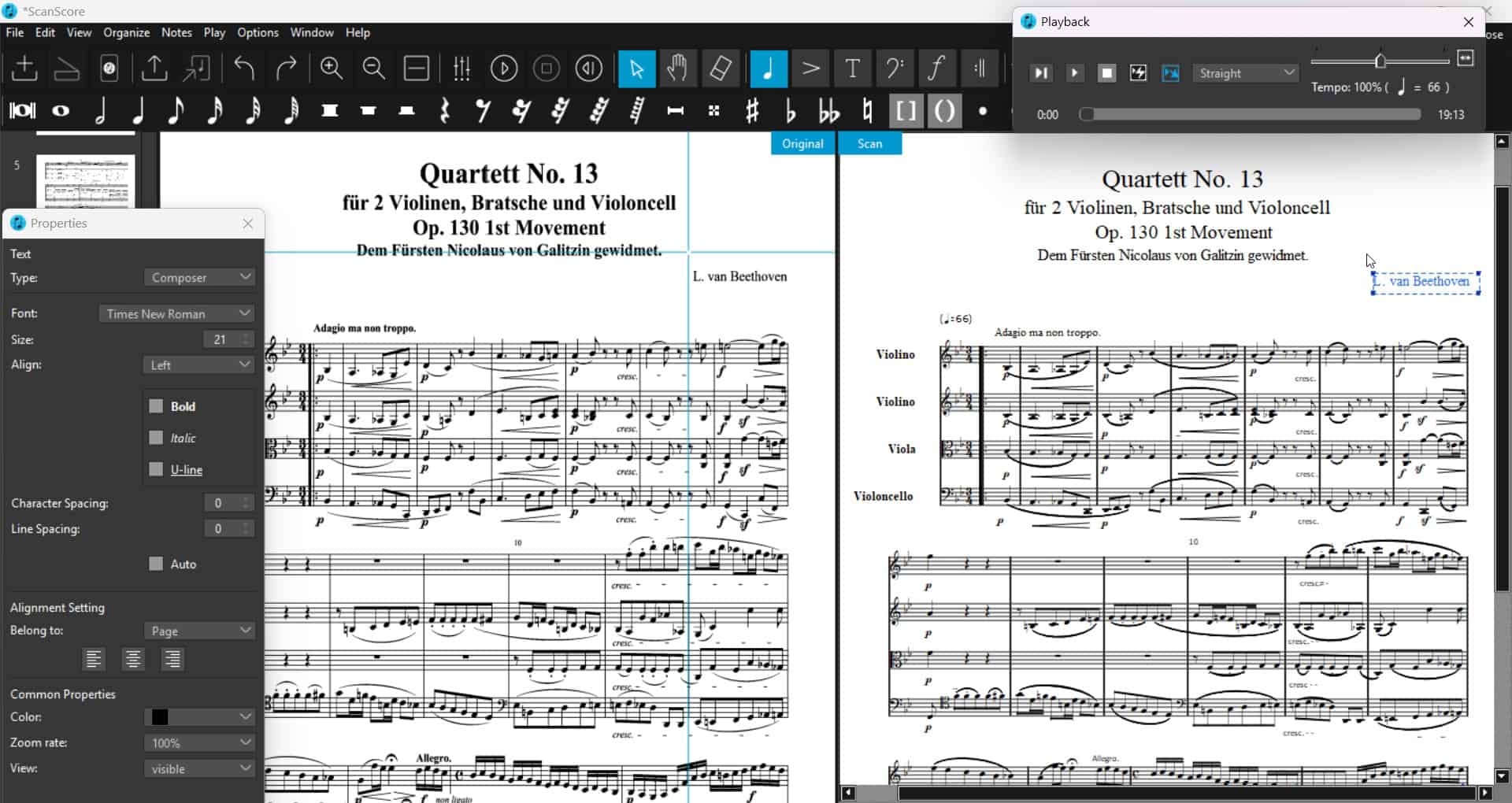
The score collection your organization has built over decades exists in two formats: physical scores and scanned PDFs. Both are at risk. The physical materials deteriorate. The PDFs are readable today but are structured as images — inaccessible to search, analysis, or any software that needs musical data rather than pixels.
Long-term preservation requires a third format: structured musical data.
Why Is PDF Not an Archival Format for Music?
Libraries and archives that shifted from physical scores to PDF assumed the digital format solved the preservation problem. PDFs don’t yellow or tear. They’re easy to copy and distribute. They feel like an improvement over paper.
But a scanned PDF score is an image, not a musical document. It can be viewed. It can be printed. It cannot be searched for a specific key signature, queried for rhythmic patterns, analyzed harmonically, or used as input to music software that requires structured data.
Music archive digitization that stops at PDF has preserved the visual appearance of the score but has not preserved the musical information in any usable form. As music software evolves and access needs change, the limitation of image-only archives becomes more visible.
A scanned PDF archive is preservation of appearance. MusicXML archive is preservation of content.
Why Is MusicXML the Right Archival Target?
Open Standard With Guaranteed Long-Term Readability
MusicXML is maintained by the W3C Music Notation Community Group as an open XML standard. No single vendor owns it. Software that reads XML can read MusicXML. The format doesn’t depend on a specific application remaining commercially viable.
A musicxml preservation archive doesn’t become inaccessible because a software company discontinues a product or changes a file format. It remains readable across software generations.
Structured Data That Software Can Actually Use
A convert pdf to xml workflow produces MusicXML files where every note has a pitch, duration, voice assignment, and set of attached markings. That structure is machine-readable. Future researchers can query it, analyze it, and use it in applications that haven’t been built yet.
Meets Grant and Institutional Requirements
Many funding bodies and institutional policies require digital collections to be in open, structured formats. Music archive digitization workflows that produce only image-based PDFs may not meet those requirements. MusicXML satisfies structured data requirements for music collections.
How Do You Approach a Large-Scale Digitization Project?
Prioritize by rarity and fragility. Not every score in a collection needs immediate conversion. Start with materials that exist nowhere else — unique manuscripts, rare editions, items in fragile physical condition. These are the collections where loss is irreversible.
Assess scan quality before conversion. Conversion accuracy is directly tied to source quality. A high-resolution, clean scan converts accurately. A low-resolution scan with faded ink produces lower-quality output that requires more post-conversion review. Assessment before conversion identifies which materials need better scanning before the conversion step.
Use the musicxml output alongside the original PDF, not as a replacement. An archival workflow should maintain the original PDF as a visual reference while adding the MusicXML as the structured data layer. The PDF preserves the original layout. The MusicXML preserves the musical information. Both serve different access needs.
Establish a metadata schema before you begin. Converted scores need searchable metadata — composer, title, date, instrumentation, edition source. Define this schema before batch conversion so that every file is cataloged consistently.
Document conversion decisions and review procedures. A conversion project produces output that requires review. Document what was reviewed, by whom, and what was corrected. Future users of the archive need to know the provenance and quality level of each converted item.
Frequently Asked Questions
Can you convert a PDF to an XML file?
Yes. Specialized PDF to XML conversion tools can extract structured musical data from scanned PDF scores and output it as machine-readable MusicXML, enabling searchability and software integration that image-based PDFs cannot provide.
What is the MusicXML file format?
MusicXML is an open XML standard maintained by the W3C Music Notation Community Group that represents musical notation in structured, machine-readable form. It preserves all musical information—pitch, duration, voices, and markings—making it ideal for long-term archival and software integration.
Is XML file the same as PDF?
No. PDFs are image-based visual documents, while XML files contain structured, machine-readable data. Converting PDF scores to MusicXML transforms them from images into data that software can analyze, search, and process—essential for preservation and future usability.
Can I convert a PDF to MuseScore?
Yes. MuseScore and other notation software can import MusicXML files converted from PDFs, allowing you to edit, analyze, and work with archived scores as editable documents rather than static images.
How Do You Create an Archive That Survives Software Change?
Music archive digitization built on MusicXML produces collections that aren’t dependent on any particular software ecosystem. The format is open. The data is structured. Future applications can read it without any migration effort.
Musicxml preservation is not just a format choice — it’s a commitment to maintaining access regardless of how the software landscape changes. The archive that converts today is protected against the format obsolescence problem that has affected generations of digital collections.
The score collection your organization has built deserves to be accessible indefinitely. MusicXML is how you ensure that.